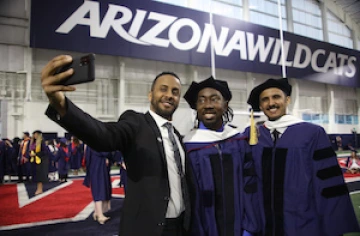
President's 2026 Commencement Welcome
Good evening… what a night!
My greetings to our Regents, distinguished guests, honorary degree recipients, faculty and staff colleagues, family and friends gathered from far and wide, and most especially… to all of our Wildcats who will receive a degree today. It is my great privilege and pleasure to welcome you to the University of Arizona’s one hundred and sixty-second Commencement.
Let me first thank all our military-affiliated students and community members for their service to our nation. Would you please stand and be recognized?
Graduates, as we begin, let us take a moment to recognize everyone who has supported you throughout your U of A journey and helped you reach this moment tonight. Would all of the parents, grandparents, siblings, spouses, families and loved ones please stand so we may express our sincere thanks?
Thank you, on behalf of the entire U of A community and of everyone graduating today – our students could not have done this without you! This moment is also for you — congratulations.
Class of 2026, you are graduating into a time of unparalleled change. The rapid advancement of technology today only existed in imagination for previous generations, who could never have envisioned the challenges, opportunities, and discoveries that would come with it.
Each one of us has seen how Artificial Intelligence (AI) has grown as a useful tool that is increasingly intertwined in our daily lives… but also introduces questions about what’s real and what isn’t. With the rise of a quantum ecosystem, biotechnological innovations, the tantalizing potential of fusion energy, and continued space exploration taking us further than humans have ever gone before, the one thing we can be certain of is that you will be faced with a world that is brimming with new possibilities and new challenges.
So, how do you prepare yourselves for this change? In the words of author, towering intellectual and civil rights activist James Baldwin:
“The purpose of education… is to create in a person the ability to look at the world for himself, to make his own decisions, to say to himself… this is black or this is white, to decide for himself whether there is a God in heaven or not. To ask questions of the universe, and then learn to live with those questions, is the way he achieves his own identity.”
At the U of A, our purpose is not to tell you what to think, or to give you all the answers, but to equip you with information, with cultural awareness and a liberal education, and with the right tools and skills, to find the answers for yourself.
When you find yourselves in a world you hadn’t expected, I leave you with three things to keep in mind:
First: Be curious. As Baldwin says, ask questions of the universe. Think critically about the answers that come your way.
Second: Be resilient. In another one of Baldwin’s essays, he says, “Not everything that is faced can be changed; but nothing can be changed until it is faced.”
When you face things that cannot be changed, remember that you have all that you need within you to carry through. Remember to live with the Bear Down spirit.
And third: Make a difference. One final thought from James Baldwin: “It is your responsibility to change society if you think of yourself as an educated person.”
After asking questions, after facing new challenges, you might find the answers untenable, or indeed, that there are no answers. Then, you must decide how you want to make a difference, how you want to create the tolerant and compassionate society you want to live in.
The U of A’s historic and living land-grant mission is so important precisely because we are here not just to educate but to serve. And when you graduate, you become part of that service to the world.
No matter where you go next—whether it is graduate school, the start of a promising career, or some other path of service—your alma mater is here to support you. We are always rooting for your success.
Graduation means different things to different people: the achievement of a longstanding goal, a transition from one phase of life to another, or simply the first step to unlocking your aspirations on an exciting journey. The one thing it does not mean is an end to your education. You will always be asking questions, and you will always be learning.
Class of 2026, congratulations! Be curious, be resilient, and whatever you go on and do, make a difference and be a force for good. Bear Down!
2026 Commencement Speaker
President Garimella, Dean Garzione, members of the Board of Regents, distinguished members of the faculty, proud families and friends, and most of all, graduates of the Class of 2026: Congratulations and thank you for inviting me to address this. It's really an honor for me to be here.
I remember how I felt when I was sitting in your seats and I had just finished my doctorate. It was 1982 and that year, TIME magazine selected its first ever Person of the Year. And it was not a person at all. It was a machine. It was the personal computer.
I remember that moment so well because I had spent my graduate years working on those machines. And we were sure we were going to change the world. And in many ways, we did. Over those next four decades, those bulky machines with green writing on a black screen became the laptop and the smartphone and with that came the internet and social media and then the cloud. And ultimately what emerged was the supercomputer in your pocket that is probably buzzing right now.
The optimism of that era, and I remember it well, was overwhelming. We believed that connecting every human being on Earth to each other and I really believe this and all of the world's information would be an unambiguous good. We believed that it would democratize knowledge, lift people out of poverty and make us wiser and kinder and more curious about each other. In a sense, we thought that we were adding stones to a cathedral of knowledge that humanity had been constructing for centuries.
But the world we built turned out to be more complicated than we had anticipated. The same tools that connect us also isolate us. The same platforms that gave everyone a voice like you're using now also degraded the public square. They rewarded outrage. They amplified our worst instincts. They coarsened the way we speak to each other and that way and in the way that we treat each other in the in the essence of a society.
In the years after I graduated, no one sat down and resolved to build a technology that would polarize democracies and unsettle a generation of young people. That was not our plan, but it happened.
I tell you all of this because last December, TIME magazine selected its person of the year for 2025 and this time it was the architects of artificial intelligence. Interesting.
Today we stand on this edge of another technological transformation. One that will be larger, faster and more consequential than what came before. It will touch every profession, every classroom, every hospital, every laboratory, every person and every relationship you have.
I know what many of you are feeling about that. I can hear you. There is a fear. There is a fear in your generation that the future has already been written, that the machines are coming, that the jobs are evaporating, that the climate is breaking, that politics is fractured, and that you are inheriting a mess that you did not create.
I understand that fear. It's rational. And it's amplified every day by social media platforms with algorithms that have learned, with great precision, that fear earns clicks and that anxiety drives engagement.
But I want to say something to you this evening as clearly as I can. To speak of the future as though it has already been decided is to surrender the one thing that actually matters. You are surrendering your agency.
The future does not simply arrive. It gets built in laboratories, in dormitories, in startups, in classrooms, in legislatures. And the people building it will be you and people like you. So the question is not whether AI will shape the world. It will. The question is whether you will help shape artificial intelligence.
We do not yet know the precise contours of what this transformation will look like. But we do know it will require each of us to adapt in ways that we cannot yet anticipate.
My hope is that you will choose to engage anyway. That you'll choose to be in the room where these decisions take place and to have a voice in how they're made.
When you are in that room, bring something with you. Bring the values that make us human in the first place. The technology, on its own, is just a tool. It will optimize for what we tell it to optimize for. But somebody has to decide. And in your lifetime, that somebody will be you.
So choose freedom. Choose open debate, and the slow, often messy, but beautiful project of learning to live alongside people with whom you disagree. Choose equality. Choose a diversity of perspectives, including the perspective of the immigrant who has so often been the person who came to this country and made it better.
America is at its best when we are the country that ambitious people want to come to. Let us not lose that.
But above all, choose respect for one another, and for the basic, unfashionable idea that the person on the other side of the argument is still a person.
If we build artificial intelligence that reflects those values, the world will be unimaginably better for it.
So, let me tell you what I am hopeful about, because, on balance, I am deeply optimistic, and I believe that you should be as well.
Consider science. So much of human progress is the story of science and medicine, and artificial intelligence is already accelerating research at a rate that we could not have imagined even 5 years ago. We have only seen maybe one percent of what is to come.
AI is now designing new molecules, running simulations, and identifying patterns in genomic data that no team of humans could uncover in a lifetime. AI has solved the 50-year-old protein folding problem in a matter of months. The next generation of antibiotics will come from this work. The next generation of cancer treatments will come from this work. The materials that will allow us to scale clean energy will come from this work.
Or look at astronomy in a field with which this university excels. Dr. Jannuzi and the team at the Steward Observatory are building a telescope more powerful than Hubble. That work, which is changing the understanding of the universe is happening here, in Tucson, right now, and in this stadium. I'm very proud of this.
And if science is not your passion, that's okay because AI is going to touch everything else as well. Whatever path you choose, AI will become part of how work is done. If you have an idea for a company, you can build a website overnight. If you want to learn something entirely new, you can have a personal tutor, in any language, for the cost of an internet connection, you can have it. If you see a problem in the world you want to solve, you can now assemble a team of AI agents to help you with the parts that you could never accomplish on your own. When someone offers you a seat on the rocket ship, you do not ask which seat. You just get on. Graduates, the rocket ship is here.
Let me give you some advice. First, find a way to say yes. Say "Yes" to the invitation. Say "Yes" to a new city. Say "Yes" to the project that is beyond your reach. “Yes” is how you get your first job and how you get your next one. “Yes” is how you stand out in a crowd. “Yes” is what keeps you young, long after the rest of you begins to slow down. The people I most admire in my own life are the people who, somewhere in their twenties, your age, said yes when others said no.
Second, build a team. Don't try to do this alone. Nearly everything I have done in my career that has proven to be worthwhile, I did with a team. For most of those years, I had a coach named Bill Campbell who counseled everybody in Silicon Valley before he died. And he used to say, "Work the team, then work the problem. The team comes first." So tonight, before you leave this campus, look around you. Some of the people sitting near you will become the most important people in your life. Don't lose touch with them. They're your team.
Third, fail quickly, and pivot without shame. The frontier exists only at the edge of what may not work. If everything you are doing is successful, you're not pushing yourself hard enough. The people that I have watched who accomplish the largest things in life are not those who avoided failure. They're the ones who became entirely unembarrassed about it.
Finally, bet on yourself. You're good. Bet on your passion. Bet on your tenacity. Bet on your voice. Bet on your values. Bet on everything that's about you. Bet on the thing that you can see that other people cannot see about you. The world will give you many great reasons to discount your instincts. Do not. The intuition you have about what matters is the most valuable signal that you can possess. Trust it.
Above all, I want you to remember something. The AI models will continue to become more powerful. As they do, the question you will face, again and again is: what do I bring?
Here is the answer. You bring the judgment. You bring the conscience. You bring the perspective. You bring the moral sense to know what is worth building and what is not. The scientist who decides which question to ask, that will be you. The architect who decides what to design, that will be you. The citizen who decides what kind of country we're going to be, that will always be you.
In the end, people like Carlo Scarpa, who is graduating with his degree in computer science tonight, will decide what our future looks like. His father Paul missed my commencement speech at his graduation in 2004 because Carlo was being born. Tonight, his father is here to watch his son step into this new future where the builders will always outrun the bystanders.
So to Carlo and his classmates, protect what makes you human. And I do not mean in the abstract. I mean specifically, concretely, in the small decisions that you make about what you build, how you build it, and for whom you build it. As you take your place in that cathedral of knowledge, this extraordinary institution at Arizona, your judgment and conscience will only become more important. Your humanity is not a handicap. That’s the entire point.
AI is not taking the future from you. It's offering you a larger future than any generation in history has ever offered. The question is now what you choose to do with it.
When you're my age, you'll look back 50 years from now and you I promise you that the things that you'll care about will not be the grades, the salaries, or the titles. It'll be the friends. It'll be the people who took the call. The mentor who believed in you before you believed in yourself. The partner with whom you shared a life. The team that built the thing that no one believed could be built.
Every one of us on this stage is, in some measure, in awe of you and I tonight. We are in awe of your youth. We are in awe of the mess you're going to make. We are in awe of the people you have not yet met, who will go on to change your lives.
And I'll give you one final reflection. Happiness, I have come to believe, is not the same as joy. Happiness is derived from meaning. Meaning in your work. Meaning in your relationships. Meaning in your place in the world, and the purpose that drives you. Find that, and the rest will take care of itself.
Congratulations to all of you. The future is not yet finished. It is now your turn to shape it.
Thank you very much, and good night.
2026 Commencement Speeches & Presentations


2026 Honorary Degree Recipients
Eric Schmidt was awarded an honorary Doctor of Science from the U of A College of Science. He is one of five honorary degree recipients.


2026 Alumni Achievement Awardee
I'm not usually one without words to say, but I am humbled and truly honored to receive this award.
As a kid who grew up in the westside of Tucson and remembers listening to football games OUTSIDE of this stadium. This is truly remarkable. Only at the University of Arizona could this be a reality.
When I sat where you're sitting today, the person that mentored me, challenged me, and FORCED me to think differently received this exact award. The law school bears his name, Arizona alum James E. Rogers.
Jim, thanks for all you did for me. We miss you.
Let's give a round of applause to what this evening is about: The University of Arizona Class of 2026!
Shout out to the San Miguel Cristo Rey Graduates! You have my heart.
Arizona grads, you made it. Yes, and not just academically. You survived 8:00 a.m. classes. Yes. Group projects where there was that ONE PERSON who mysteriously “had Wi-Fi issues,” and the emotional rollercoaster of the Final Four. My heart still hurts. But GO CATS.
I know what some of you are thinking: “Do I feel READY for the real world?” And the answer is… absolutely NOT. But that's kind of the point.
The University of Arizona has given you more than just a degree. It has given you resilience, amazing friendships, and the mental ability to deal with questionable decisions of all sorts!
Those skills are critical, and I'm grateful to have them.
And let's not forget your parents and families who supported you and encouraged you. TODAY is their day, too. They officially get to ask you, "So, what's next?" and they get to answer, "A JOB."
A JOB because this university, which gave you its SOUL needs you to support it. Especially the College of Education, because we need to continue to produce badass teachers. We all had them!
As you step into this next chapter, you'll hear lots of advice – like the magic of compound interest, which truly is magical. Ask Dr. Eric Schmidt.
Follow your passion. Take risks. Network. Update your LinkedIn profile.
REMEMBER – you don't have to have a perfect path. Some of the best opportunities come from the unexpected. I know. Life is like a box of chocolates.
One day you're walking down University Boulevard, next you're wondering if you made the right career move.
But there's something simple: it's okay, you don't have to have everything figured out. NOBODY DOES.
So go out there, be BOLD. Be CURIOUS. But most of all, be the kind of person who MAKES things better – not just for yourself, but for others.
And as Secretary of State, I would not be doing my job if I didn't tell you to register to vote – and ACTUALLY [ __ ] vote. Sorry, Mom.
You have the power. Young voters can change the direction of this country.
And wherever you go, carry a little bit of TUCSON with you. The sunsets, the grit, the pride – and the deep, unshakable belief that yes, 100 degrees can feel like “a nice day.”
Class of 2026, you did it. You earned this moment. Now go celebrate… responsibly. Actually, just have fun.
Wildcats – Bear down! Good luck.
2026 Outstanding Senior Awardees


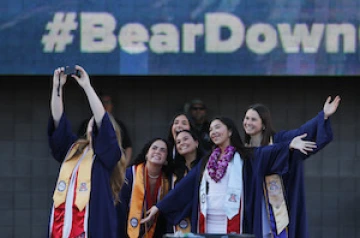
Tag Your Photos
#BearDownGrad #WildcatforLife
It's a great way to share your Wildcat pride with us and your fellow graduates.